
The strongest small-business AI workflows begin with existing work and a bounded result. This article describes practical deployment patterns rather than claiming an adoption rate or reporting customer studies. Its examples are illustrative. The distinction matters: a pattern can be useful without pretending it has delivered measured results for a named business.
Acquisition and website work
An operator can give AI a reviewed service brief and ask for a landing-page outline, draft FAQ or alternative explanation of an offer. The useful context includes audience, exclusions, evidence and the intended next step. Someone must check that the draft does not broaden the service promise or invent proof.
For ongoing website management, start with an inventory of current pages and an approved change. “Update the seasonal opening hours on these pages” is easier to verify than “Improve our website.” Preview the revision, preserve important URLs and test the contact flow after publishing. Learn more in the website creation lifecycle.
Support and internal knowledge
Support drafting works best against maintained policies, not a pile of historical messages. Label each source by owner and effective date. Ask for the relevant policy reference with the answer. When sources disagree or the customer requests an exception, escalate.
Internal knowledge search has a similar constraint: the user should receive only information they are authorized to access. A summary must not erase the difference between an approved policy, a discussion and an abandoned proposal. Remove stale documents from active reference sets, while retaining historical records where the business needs them.
Proposals, research and analysis
A proposal assistant can organize requirements, prepare a scope outline and identify questions. Keep price, deadlines and commitments under human control. Do not let a fluent draft imply that feasibility has been assessed. Compare the final scope with the customer's original request before sending it.
Research assistance can collect leads to sources and organize competing explanations. Follow the source links, check dates and distinguish a vendor claim from independent evidence. Analysis assistance can explain a dataset only after its columns and business definitions are clear. Reconcile totals first; a persuasive explanation of incorrect numbers is still incorrect.
| Work type | Input to maintain | Review question |
|---|---|---|
| Proposals | Approved scope and pricing policy | What commitment did the draft introduce? |
| Support | Current policies and account context | Is this answer authorized and current? |
| Research | Source criteria and research question | Does the source support the claim? |
| Analytics | Definitions and reconciled data | Are calculations and assumptions checkable? |
Workflow automation and coding
Generating a message is different from sending it. Proposing a website change is different from deploying it. Separate these steps so an operator can review business consequences. Give tools the smallest useful permission set and keep records of actions.
For coding or no-code work, begin with a written acceptance test. Describe the intended customer journey and data rules. Review how generated code handles authentication, storage, errors and retries. Publishing an application requires someone to own its running environment, updates and recovery; AI assistance does not eliminate those duties.
Make a repeatable operating pattern
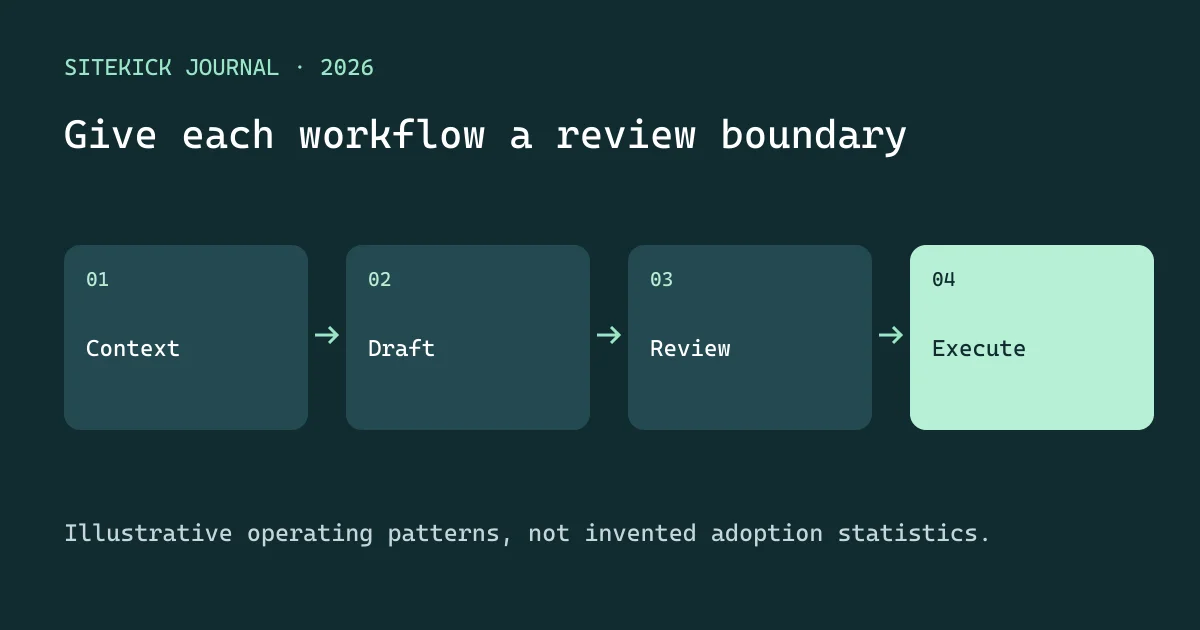
Use five steps: supply approved context, request a bounded output, review it against the source, execute through the authoritative system and inspect the result. Record corrections so the team can improve instructions and source material. Retest when a model, integration or policy changes.
In Sitekick, distinguish the available WordPress-based CMS from Studio's private beta. Broader management ambitions should be evaluated through actual demonstrations. The website-manager guide explains how to turn repeated assistance into a clear operating contract instead of an open-ended promise.