
A website builder produces a site. A website manager works within a continuing responsibility: keeping information accurate, customer actions dependable and changes recoverable. Before asking AI to take on that role, write down what management means for your business.
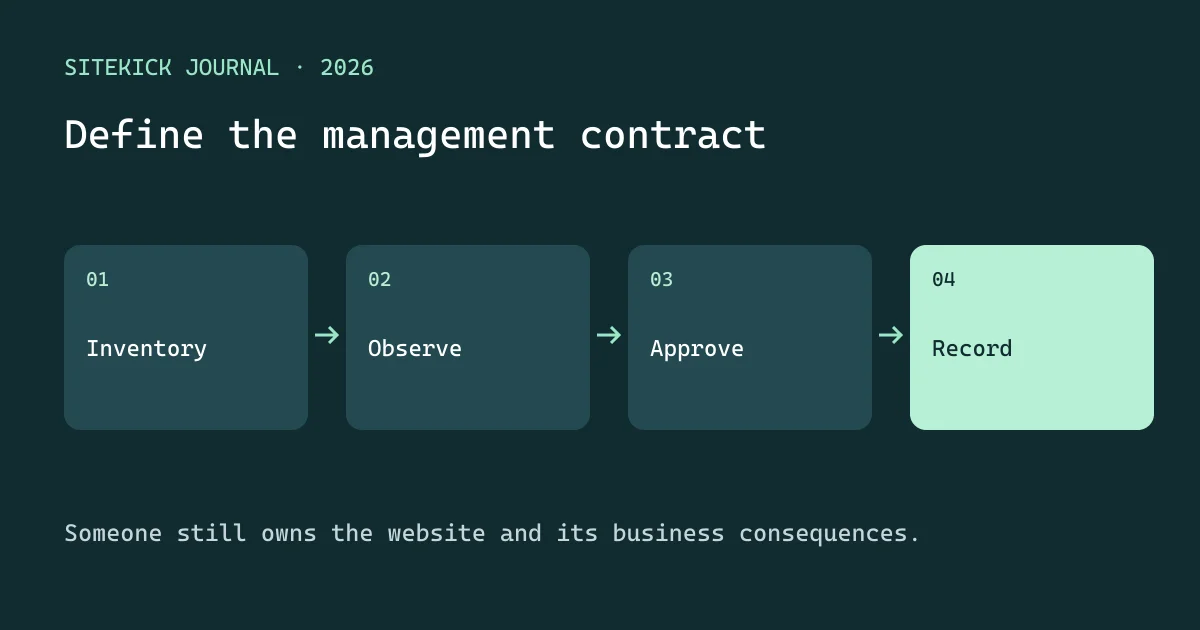
Inventory the website as an operating asset
List public pages, original media, forms, booking tools, payment routes, domains and connected systems. Record who owns each one and which account controls it. Include service descriptions, prices and policies that appear in more than one place.
For an illustrative professional-services firm, the same response-time promise may appear on its contact page, landing page and automated reply. Updating one location while leaving the others unchanged is a management failure even if the edited page looks correct.
Define a service contract
Decide what will be monitored, how often, what qualifies as a problem and who receives it. “AI takes care of the website” is too broad. A useful contract might cover broken internal links, form delivery checks, proposed content corrections and a monthly owner review.
| Responsibility | Routine assistance | Owner decision |
|---|---|---|
| Content accuracy | Identify inconsistent facts | Approve the correct facts |
| Customer journeys | Run defined checks | Decide service commitments |
| Search hygiene | Flag missing metadata or broken URLs | Approve URL and content strategy |
| Improvements | Prepare a scoped proposal | Approve publication |
| Incidents | Collect evidence and alert | Decide containment and recovery |
Distinguish a detected issue from a repaired issue. A report saying a form failed should include the tested route and observed failure, not merely a confident statement that it is fixed.
Maintain approved business context
Keep a current reference set with owners and review dates. Separate draft plans from active policies. When services change, update the reference first, then identify dependent pages and messages. Do not let accumulated chat history become an unofficial policy database.
An AI manager should be able to explain which facts support its proposal. If the reference does not answer a question, it should ask the owner. This is especially important for service exclusions, prices and customer-specific information.
Build a change and approval path
Require a preview that shows the scope and reasons for a change. Check factual accuracy, mobile behavior and customer actions. Record the approval, publish through the appropriate system and verify the resulting page. Keep a restoration point.
Use narrower permissions for routine content than for applications or financial actions. Changing a paragraph should not confer access to customer records. A rollback should restore content without undoing business events that occurred afterward.
Review the manager itself
Track missed issues, false alerts, correction effort and unexpected scope. Review the checks when the website adds a new integration or customer journey. Ask whether the system still tests what customers actually do, rather than only loading the homepage.
A modest monthly review can inspect contact delivery, current facts, key search pages and recovery access. After a significant change, perform the relevant checks immediately instead of waiting for the schedule.
Sitekick AI CMS and Studio use different operating models. CMS is the available WordPress-based product; Studio is a private beta with broader management ambitions. Ask either provider for its actual responsibility boundaries and available tools. Can AI manage the website after building it? offers a concrete acceptance demonstration, while the future of builders discusses the broader direction.