
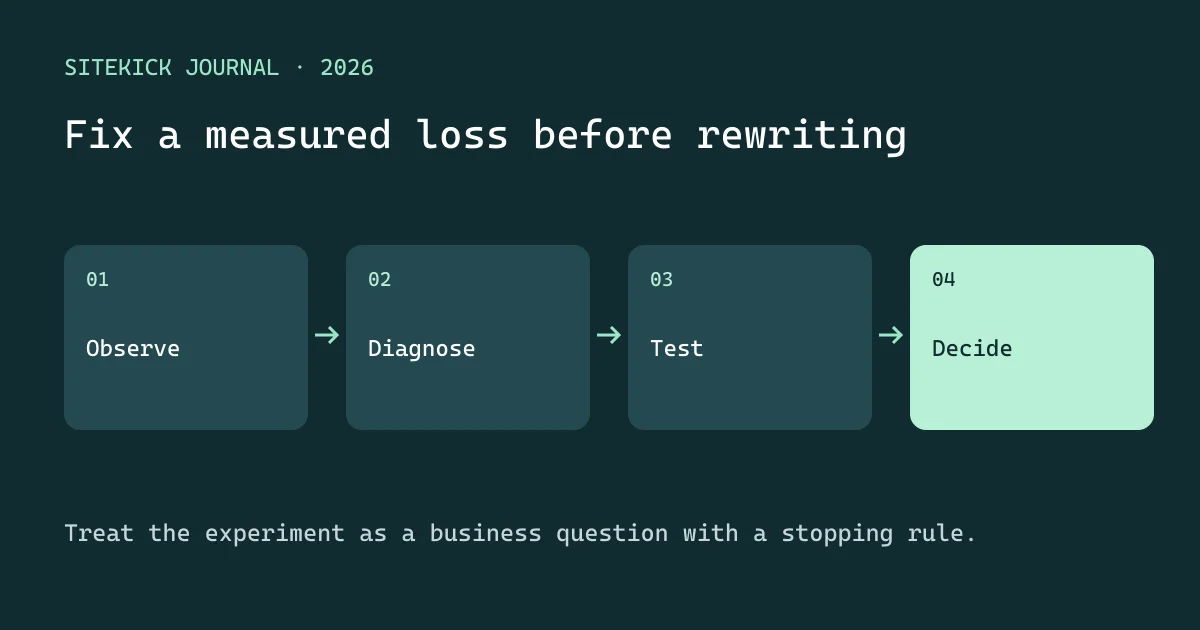
Optimization begins with a diagnosis. Asking AI to rewrite a generated page repeatedly can change the wording without addressing the reason customers leave. Find the loss, form a business hypothesis and make the smallest change that can test it.
Locate the failure in the journey
Separate arrival, engagement, action, submission receipt and qualification. A page with few clicks may have an unclear offer. A page with many form starts and few completions may have excessive questions or a validation bug. A page with many submissions and few useful conversations may attract the wrong audience.
Inspect the technical path before experimenting with copy. Send an inquiry from a phone, enter an invalid field, retry after an error and check the record in the receiving system. Review the confirmation page and notification. A broken submission handler is not a headline problem.
Use AI to organize evidence
Give AI approved material: page copy, offer details, anonymized customer objections and defined event counts. Ask it for competing explanations and the evidence that would distinguish them. Do not paste unnecessary personal information. Require it to separate observations from guesses.
For an illustrative consultant page, the hypothesis might be: visitors cannot tell whether the initial call includes a paid assessment. A useful change would clarify purpose and obligation near the button. Replacing the entire visual design would make the result harder to interpret.
Design one useful experiment
Write down the audience, change, primary outcome, observation window and stopping rule. Use suitable inquiries or attended meetings when those are the business goal, while acknowledging the delay before such outcomes appear. Track form errors and response workload as guardrails.
| Hypothesis | Focused change | Guardrail |
|---|---|---|
| Offer is unclear | Explain deliverable and exclusions | Do not broaden service promises |
| Proof is weak | Add a verified relevant example | Obtain permission and avoid invented results |
| Form asks too much | Remove a nonessential question | Preserve routing information |
| Next step feels uncertain | State response process | Promise only what staffing supports |
Have AI draft variations within the hypothesis. A person checks factual claims, tone and accessibility. Keep traffic allocation and campaign changes stable enough to interpret the result. Document any unavoidable changes in acquisition mix.
Handle small samples honestly
A small business may not have enough traffic for a rapid statistically persuasive test. Do not declare certainty from several extra clicks. Use usability observation, customer interviews and support questions to improve obvious problems while collecting longer-term outcomes. Label directional findings as directional.
Keep seasonality, source mix and offer changes in view. A new headline published alongside a discount cannot receive sole credit for an improvement. If results are ambiguous, retain the clearer version based on qualitative evidence and continue observing rather than inventing a percentage win.
Personalize only when the rule is explainable
A service-category selection can route someone to a relevant example. Maintain a sensible default and confirm that all variants make accurate promises. Avoid inferred sensitive attributes, invisible eligibility decisions or surprise price changes. Test each path on mobile and with keyboard navigation.
After deploying a winning revision, check form receipt and notification again. Keep a restoration point and record the final decision. Sitekick's CMS and Studio should be evaluated by the actual edit, preview and recovery tools available in each product. The landing-page construction guide covers the initial page; the customer workflow guide covers the action after submission.