Your business may benefit from an AI-powered website, but the useful question is where it repeatedly loses time or customers. A stable brochure site for a fully booked local practice may need little automation. A service business handling changing offers, several customer types and frequent inquiries has a different operating problem.
Separate creation from operation
AI-assisted generation helps produce a first draft. Operation includes correcting facts, keeping availability current, answering questions, capturing inquiries and making sure the right person responds. A site can look finished while failing at all of those tasks.
The opportunity in 2026 is to evaluate AI across this lifecycle. Current builder pages increasingly describe editing and business tools alongside generation. That does not establish that autonomous management is reliable. It gives buyers a reason to ask what happens after publication.
Find a recurring task worth improving
Consider an illustrative repair company that changes its service area seasonally. Its website needs accurate coverage pages, inquiry routing and clear scheduling expectations. AI could draft coverage updates from an approved list and summarize inquiry details. The business should still own eligibility decisions and appointment promises.
For a restaurant with a simple menu and phone bookings, a conventional site with accurate hours may be enough. Adding a conversational agent that guesses table availability could make the experience worse. An automation should remove a known inconvenience without introducing an unsupported promise.
| Situation | Reasonable starting point | Evidence to request |
|---|---|---|
| Frequent content changes | AI-assisted draft updates | Preview, factual review and restoration |
| Repeated inquiry sorting | Summaries and rule-based routing | Stored inquiry and assigned owner |
| Repeated customer questions | Approved answer library | Sources and escalation route |
| Rarely changing information | Simple maintained pages | Accuracy and dependable contact |
Treat personalization as a service decision
Personalization can mean showing a relevant service page based on a visitor's chosen category. It should not mean guessing sensitive attributes or changing prices without a clear policy. Keep the experience understandable and test a default route when context is absent.
For customer self-service, begin with facts you can maintain: service coverage, preparation instructions and status information drawn from an authorized record. Give the customer a human contact route. A fluent answer is not proof that it came from the right account or current policy.
Connect the website carefully
A website becomes an operating surface when its actions connect reliably to other systems. A form must store data; a booking must reserve real capacity; a payment must produce a verified transaction; a content change must preserve important URLs. Document the authoritative system for each fact. When two systems disagree, an AI agent should escalate rather than choosing the most plausible answer.
Keep access proportional to the task. A content assistant should not need permission to issue refunds. A support assistant should not retrieve unrelated customer records. Use previews and approvals for changes that affect prices, promises, customer data or public claims.
Decide with a bounded pilot
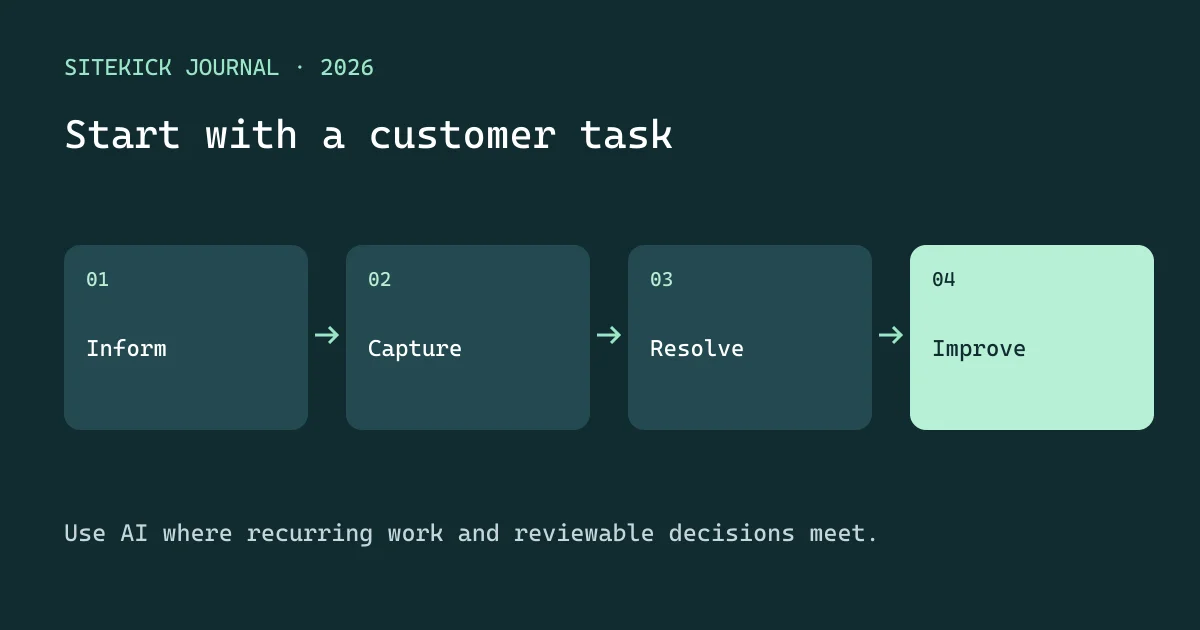
Pick one recurring task, record its manual effort and define a satisfactory result. Try the workflow with human review. Include errors and corrections in your assessment. Do not count a faster draft as a saving if reviewing and fixing it takes longer than doing the task directly.
Sitekick AI CMS is the available WordPress-based product. Studio's private beta explores a broader website-and-business-application operating model; assess it through its current access process rather than assuming broad availability. The management acceptance guide turns this evaluation into a concrete demonstration.