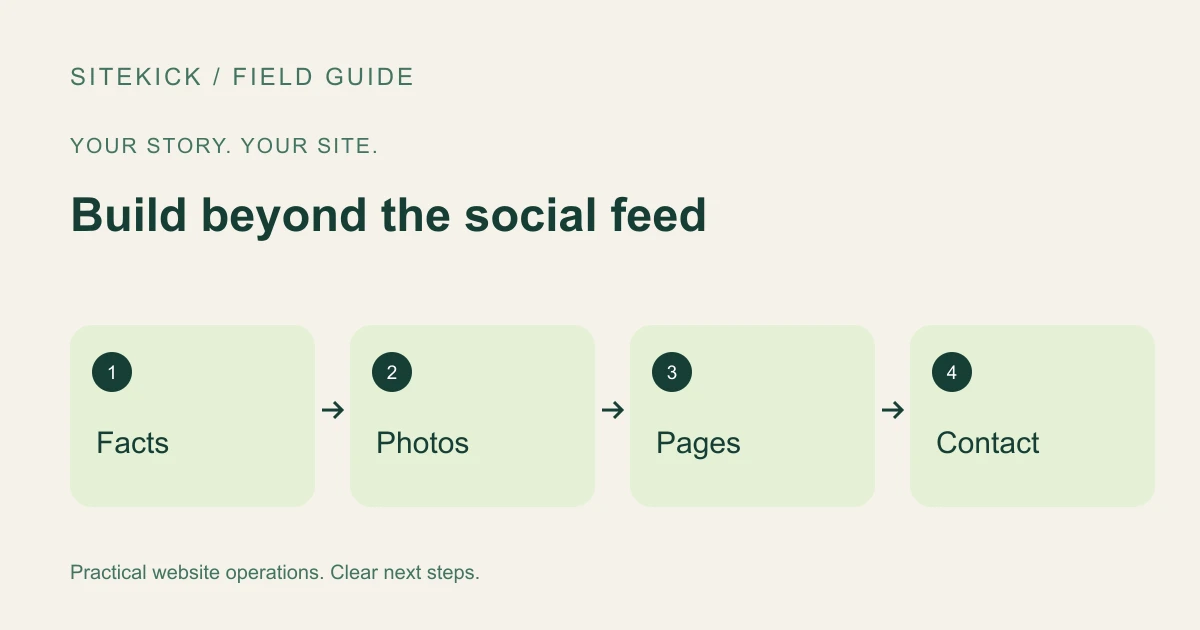
Your social profile may already contain the ingredients for a useful website: a clear description, examples of your work, contact details and questions customers ask. The work is to turn those ingredients into a reliable home for your business, rather than copying a feed onto a page.
You can prepare that material yourself without connecting an account or giving a website builder permission to access your social profile. The checklist below works with content you own or have permission to reuse. It does not depend on automatic LinkedIn or Facebook imports.
Try this next
See a starting point for your website.
Try a free browser preview, then decide whether to continue with SiteKick CMS. No account is needed for the preview.
Prepare a small, reviewed content pack
Start with a plain-text business description. Include what you do, who you help, where you operate and the next step you want a visitor to take. Add your current contact details and a short list of services or products.
Choose a few photos that show the actual business or work. Check whether you have permission to publish them on your own website, especially when another photographer or a customer supplied them. Keep private messages, customer personal information and account screenshots out of the pack.
For a professional profile, separate current responsibilities from previous roles. Verify dates, titles and credentials. A concise, accurate biography is more useful than a longer one padded with achievements you cannot support.
Build pages around questions, not the feed
A social feed is chronological. A website visitor usually has a specific question. What do you offer? Is it appropriate for them? Where do you work? How can they get in touch?
Use those questions to plan the site. A practical starting structure is a homepage, a services or work page, an about page and a contact page. A business with one focused offer may not need four separate pages immediately. Keep the structure proportional to what visitors actually need.
An example: a hypothetical independent designer could organize selected projects by the problem solved, with permission-cleared images and a short explanation of their contribution. That is more informative than importing dozens of posts without context.
Keep the source material honest
Review any AI-written copy against your pack. Remove invented client names, metrics, awards and endorsements. Check that a proposed service is something you actually provide. If the website summarizes a project, distinguish your role from the work of the broader team.
Do not assume a publicly visible profile is permission to republish everything on it. Avoid copying platform interface elements or implying an endorsement by the platform. Link to your own verified social accounts so visitors can continue following you there.
Choose a contact path you can maintain
Pick the primary action: inquire, book a call, view work or buy an available product. Test that path before sharing the website. If you keep a social messaging option, also consider a contact route you control so your entire inquiry process does not depend on one platform.
Review the website when your business information changes. A profile and a website can contradict each other surprisingly easily when one has old hours or an outdated role.
Explore the Sitekick CMS workflow when you are ready to turn reviewed business information into a website. Automatic social-account imports and upcoming profile-intake features are not prerequisites for preparing your content.