
October 21, 2026 | SiteKick Security Advisory
Two critical PHP vulnerabilities prompted urgent security advisories on October 21, including a warning from the National Security Agency (NSA) recommending immediate remediation.
Both vulnerabilities carry CVSS 9.2 severity ratings and could potentially allow attackers to execute unauthorized code on affected servers.
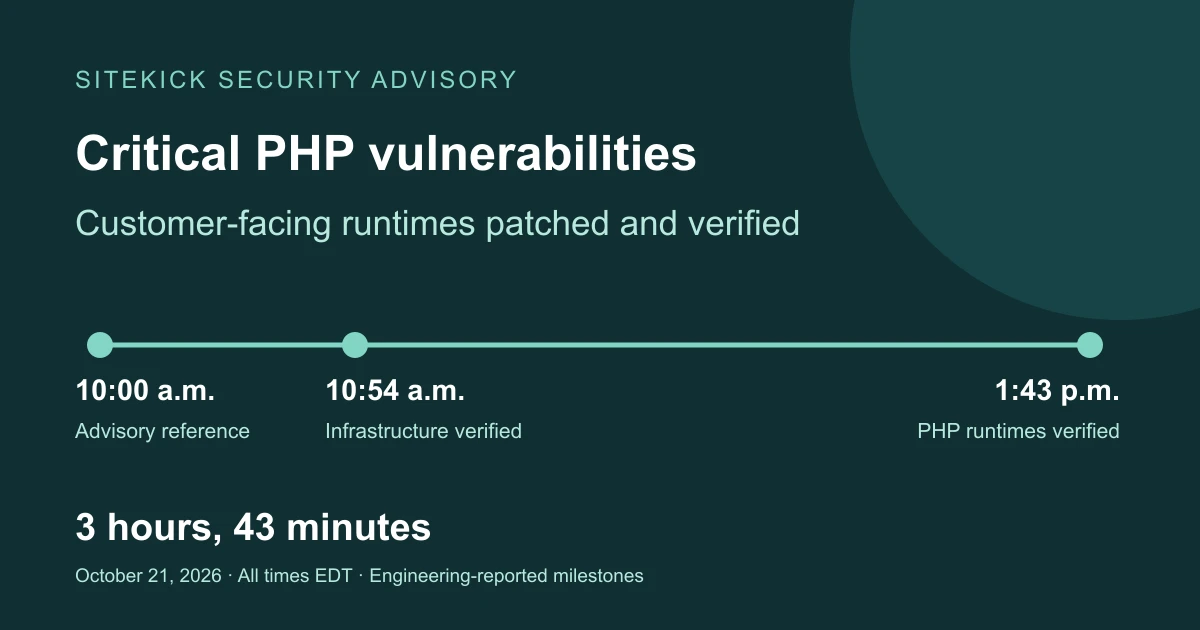
At SiteKick, our engineering teams moved immediately. Customer-facing PHP runtimes were patched and verified within four hours of the advisory's 10:00 a.m. Eastern reference time.
This wasn't simply a matter of issuing a security notification. Our teams deployed the applicable changes and confirmed remediation across the affected customer-facing PHP runtime environments.
Our response: From advisory to verified remediation
Our engineering teams prioritized the affected infrastructure and application runtime environments as soon as the advisory was released.
| Milestone | Time (EDT) | Elapsed time |
|---|---|---|
| Security advisory reference time | 10:00 a.m. | Not applicable |
| Backend Infrastructure patched and verified | 10:54 a.m. | 54 minutes |
| Customer-facing PHP runtimes patched and verified | 1:43 p.m. | 3 hours, 43 minutes |
The result: Customer-facing PHP runtimes patched and verified within four hours.
For us, effective incident response means more than identifying an update. It means deploying remediation, validating the affected environment, and reducing the period of known exposure.
What happened?
On October 21, 2026, the PHP project released security fixes for two critical vulnerabilities:
- CVE-2026-109618: A memory-corruption vulnerability associated with out-of-memory handling.
- CVE-2026-109619: A vulnerability involving stale internal state under certain error conditions.
Successful exploitation could potentially enable remote code execution on vulnerable systems.
The NSA advised organizations using PHP to prepare for immediate updates and consider taking vulnerable systems offline when they cannot be adequately mitigated.
Is your WordPress website affected?
Because WordPress runs on PHP, the vulnerabilities have implications for WordPress websites and the infrastructure hosting them.
Importantly, these are PHP runtime vulnerabilities, not ordinary WordPress plugin vulnerabilities.
Updating WordPress core, plugins, or themes does not necessarily update the PHP runtime beneath the application.
Which PHP versions are patched?
The PHP project released these security updates:
| PHP branch | Security release |
|---|---|
| PHP 8.5 | 8.5.12 |
| PHP 8.4 | 8.4.27 |
| PHP 8.3 | 8.3.36 |
| PHP 8.2 | 8.2.35 |
Organizations using unsupported PHP versions should plan migration to a supported release.
Five things website owners should do now
1. Confirm the PHP version running your website.
WordPress administrators can locate PHP version information under Tools → Site Health → Info → Server.
2. Verify remediation with your hosting provider.
Ask whether the affected PHP runtime has been updated, not simply whether WordPress received its latest updates.
3. Validate critical website functions.
After updating, verify forms, login systems, payments, content management, and other critical workflows.
4. Review security logs and monitoring.
Check for unusual access patterns, unexpected file changes, or other indicators that could suggest earlier exploitation.
5. Do not treat temporary protections as permanent fixes.
Firewalls and access restrictions may help reduce exposure, but they do not replace applying the necessary security updates.
Why response time matters
For businesses operating online, security vulnerabilities are not abstract engineering problems.
A vulnerable runtime can potentially affect customer data, operational availability, revenue-generating workflows, and trust.
The difference between knowing about a critical vulnerability and deploying a verified fix is an important operational measure.
At SiteKick, our response to this advisory demonstrates an approach we believe is essential for modern website infrastructure:
Identify. Remediate. Verify.
Our teams completed the customer-facing PHP runtime remediation and verification in 3 hours and 43 minutes.
Security is an ongoing process, and no provider can reasonably promise that every vulnerability will be prevented. What we can demonstrate is how we responded to this incident.
Building websites should not mean becoming an infrastructure specialist
Small businesses should be able to focus on customers, services, and growth rather than spending every day tracking runtime vulnerabilities and infrastructure dependencies.
That belief is part of why we are building SiteKick.
AI can make building and managing business websites easier, but responsible website operations also require maintained infrastructure, thoughtful automation, testing, and clear accountability.
Fast remediation is important. Verified remediation is what makes the response meaningful.
Learn more at SiteKick.
Official resources
SiteKick remediation timestamps reflect the engineering team's reported patch-and-verification milestones on October 21, 2026.