
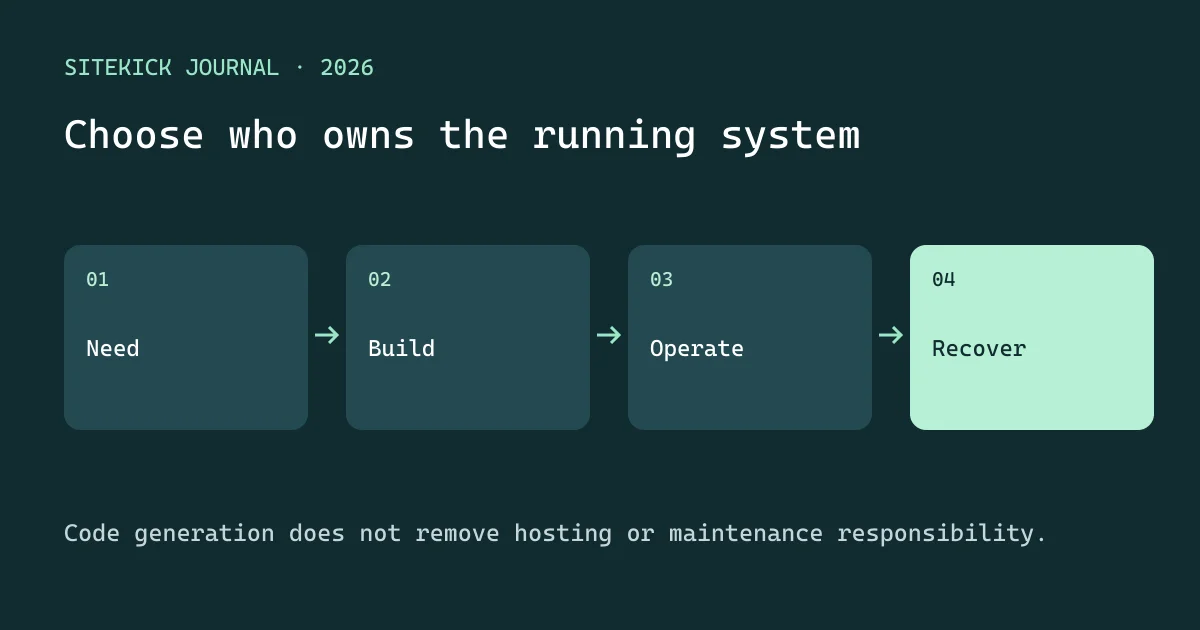
A website builder and a coding agent can both help produce a website, but they leave different responsibilities with the business. The useful choice depends on the customer journey, customization needs and who will operate the result. A generated codebase is not automatically a maintained service.
Choose the required outcome first
Write down the pages and actions customers need. A service site with articles, inquiries and ordinary booking needs may fit a packaged platform. A custom application with unusual data relationships or internal workflow rules may require more development control.
Identify non-negotiable requirements before comparing demos: authentication, data access, integrations, search output, multilingual content, payment behavior and export. Distinguish a preference for unique visual style from a requirement for unique application behavior.
Compare the operating models
| Question | Managed website-builder route | Coding-agent route |
|---|---|---|
| Where does the site run? | Typically the platform's supported hosting model | In an environment someone must choose and operate |
| How are routine edits made? | Through the platform's editor and tools | Through code changes or an added content system |
| Who maintains the runtime? | Provider covers defined platform responsibilities | Owner or technical partner must cover the deployed stack |
| How much can be customized? | Within documented platform and integration boundaries | Potentially broad, with engineering and review responsibilities |
| What happens on exit? | Depends on export and migration terms | Depends on code, data, dependencies and deployment access |
These are category-level tendencies, not universal product guarantees. Some builders allow custom code; some coding workflows include managed hosting. Ask the provider to demonstrate the actual boundary.
Test representative work
For a builder, add a service, publish an article, edit a form and restore a prior page. Check whether the business owner can maintain it. For a coding workflow, implement a small customer journey and inspect authentication, storage, errors and deployment. Have a qualified person review the generated code before relying on it.
Use the same acceptance criteria for both: accurate content, accessible mobile experience, working customer actions, correct search metadata and a recovery plan. Generation speed is one input, not the whole comparison.
Price the responsibilities
A builder subscription may bundle hosting and editing while charging separately for applications or business tools. A coding route can involve model usage, hosting, databases, monitoring and technical maintenance. Include time spent reviewing changes and diagnosing failures.
If no one can handle a deployment failure, dependency update or data-access bug, custom code may exceed the team's operating capacity. Hiring a technical partner can be reasonable, but include that relationship in the budget. Conversely, forcing a genuinely custom workflow into an unsuitable builder can create fragile workarounds.
Treat ownership as an operational question
Keep domain access, original content and customer data documented. For code, include source control, deployment accounts, configuration and dependency information. For a builder, verify what the export includes and what must be rebuilt elsewhere. In both cases, rehearse recovery before an outage.
Generated code needs review of secrets, permissions and input handling. A working happy-path demo does not prove that one customer cannot access another customer's records. Public pages and business applications need different levels of scrutiny.
A reasonable small-business decision
Use the smallest system that supports the customer journey and has a maintainable operating model. Sitekick AI CMS is a WordPress-based product available now. Studio is a private beta pursuing websites, business applications and managed operations; it should be evaluated through current access and demonstrated behavior. Neither description removes the need to verify the running result.
Use the builder comparison for packaged options, and the full website lifecycle to define acceptance criteria before choosing a tool.