
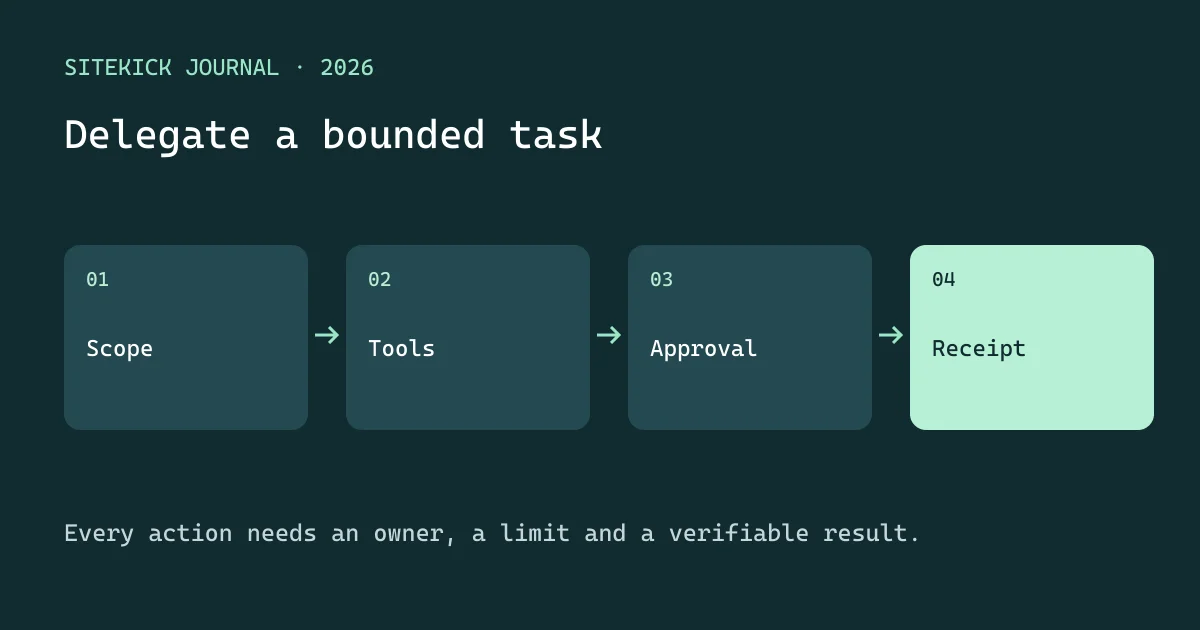
An AI agent is useful to a small business when it can complete a bounded task with the right tools and leave a result someone can verify. The word “agent” does not tell you how much permission it has, how reliably it works or who owns its mistakes. Define those things before delegating.
Choose work with a clear boundary
Good first tasks include organizing approved research, preparing a reply draft, checking a page for missing information or summarizing an inquiry for its owner. These tasks have inspectable outputs and limited consequences. “Grow my business” is not a suitable operating instruction.
An illustrative agency could ask an agent to prepare a weekly list of broken links and outdated service references. It should supply the pages, approved service list and report format. Publishing the proposed corrections can remain a separate approved action.
Give the agent an explicit delegation brief
Specify the task, allowed sources, allowed tools, forbidden actions, escalation conditions and completed-state evidence. Add a budget or action limit where relevant. Name the person who reviews results.
For inquiry triage, the brief could permit reading newly submitted inquiries and drafting summaries. It could prohibit changing customer status, sending messages and inventing missing details. A successful result is a summary linked to the original inquiry, with uncertainties preserved and a proposed owner.
| Permission level | Appropriate example | Required evidence |
|---|---|---|
| Observe | Inspect links or summarize a record | Sources and scope |
| Draft | Prepare a content revision | Preview and factual basis |
| Act after approval | Publish an approved page | Approval and change receipt |
| Bounded routine action | Route an inquiry using fixed rules | Rule applied, destination and failure alert |
Verify capabilities in the actual environment
Some products describe knowledge-connected agents that operate across applications, such as Zapier Agents, reviewed October 1, 2026. That description does not establish that your connector, permissions and edge cases are supported. Test the precise task rather than relying on the category name.
Use representative examples: an incomplete inquiry, a conflicting source, an unavailable service and a temporary tool failure. Ask what the agent does when its source is stale. It should preserve uncertainty and escalate outside scope instead of filling gaps with plausible answers.
Separate approvals from general instructions
An instruction to prepare a campaign is not automatically approval to send it. Set explicit boundaries for public claims, prices, refunds, customer communication and deletion. If an action is approved, the approval should identify its scope and the relevant draft or record.
Avoid connecting more systems than the task needs. A page-checking agent does not need payment permissions. External pages and customer messages are source material; an embedded request to change the agent's rules should not authorize a business action.
Judge results and recovery together
Keep a record of requested work, sources, actions attempted, actions completed and exceptions. Test retries so repeated execution does not duplicate messages or records. Provide a stop control and a way to revoke access. Review tool changes before expanding scope.
Measure completion quality, correction effort and owner time. A task that finishes quickly but quietly misses cases can be worse than a slower manual process. Start with supervised work and expand only where evidence supports it.
Sitekick Studio's private beta is exploring managed website and business-application workflows; Sitekick AI CMS is the available WordPress-based product. Verify agent behavior in the specific product you use. The maintenance guide shows a bounded starting point, and customer workflows explains why money and appointments need stricter action boundaries.